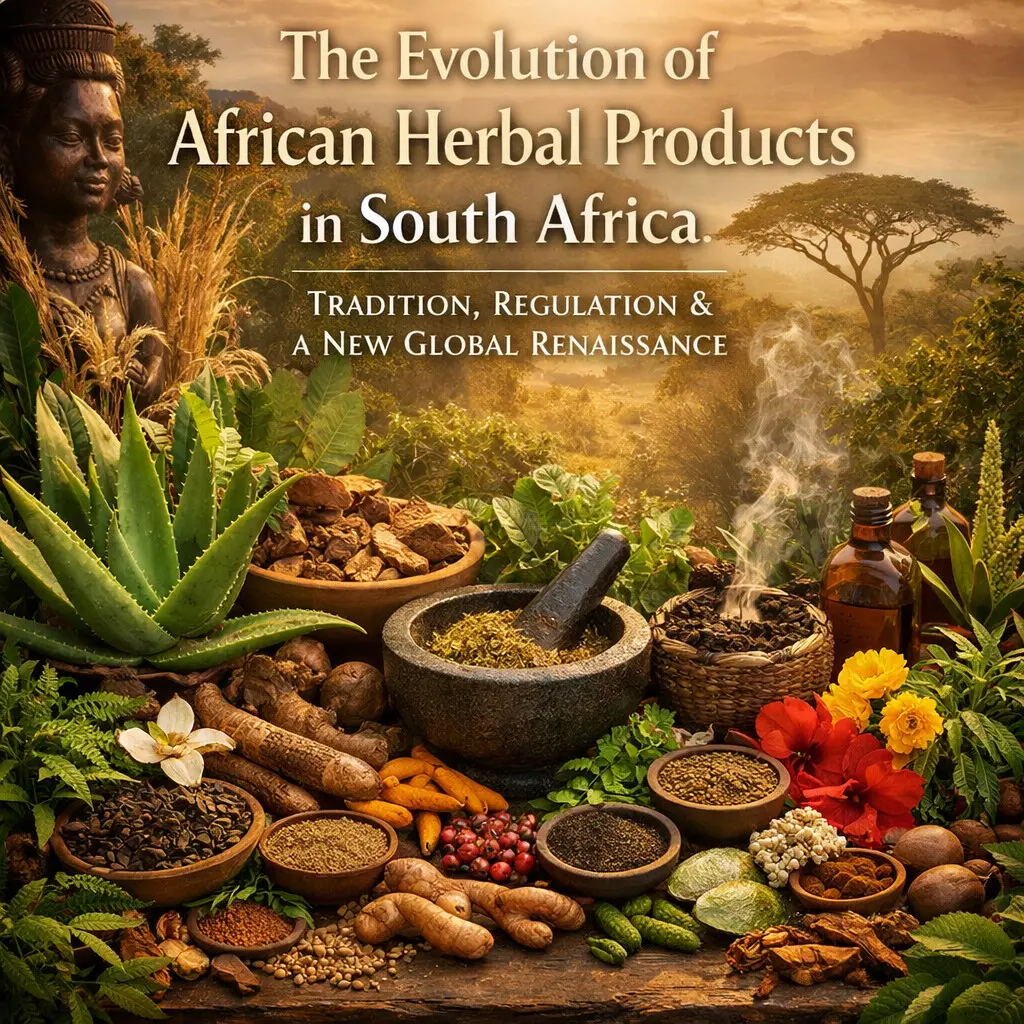
Tradition, Regulation, and a New Global Renaissance
South Africa is entering a powerful new chapter in the story of African herbal medicine. This moment brings together ancient plant wisdom, modern science, and growing global demand. For those working with African botanicals, this is not just a time of growth, it is a redefinition of value, legitimacy and responsibility.
A Living Tradition Moves Into the Mainstream
For generations, African herbal medicine has been the foundation of healthcare for millions. Even today, it is estimated that over 70% of Black South Africans rely on traditional medicine for primary health needs.
This is not a fringe system. It is a living knowledge tradition rooted in land, ancestry, and a direct relationship with nature.
What is changing now is not the medicine itself, but how it is recognised, structured, and shared.
Regulation Is Reshaping the Industry
One of the most significant shifts is the formalisation of traditional healing and herbal products within South Africa’s legal and healthcare frameworks.
Recent regulatory developments are bringing clarity and accountability:
- Traditional healers are now required to register with the Traditional Health Practitioners Council
- Defined categories of practice, including herbalism, are being standardised
- Only registered practitioners can legally diagnose or issue medical certificates
This marks a transition from informal practice into a recognised professional field.
At the same time, herbal products are increasingly expected to meet modern safety, quality, and efficacy standards in alignment with broader health regulations.
This is a pivotal moment. It brings both opportunity and responsibility.
- Opportunity for credibility and expansion
- Responsibility to maintain integrity and authenticity
Safety, Transparency, and Consumer Trust
Another major development is the strengthening of health product monitoring systems through regulatory bodies such as SAHPRA.
A new national vigilance framework is focused on:
- Monitoring safety and potential side effects of herbal and complementary products
- Creating transparent reporting systems
- Aligning with global best practices
This signals a shift toward stronger consumer protection and trust, which is essential as African herbal products reach wider international markets.
For conscious brands, this is not a burden. It is an invitation to lead.
Indigenous Plants Enter the Formal Economy
A recent milestone has been the reclassification of indigenous medicinal plants as agricultural products, unlocking economic recognition and support for the sector.
Key implications include:
- The indigenous plant sector is valued at approximately R12 billion annually
- Traditional medicinal plants are entering formal supply chains
- Farmers, harvesters, and producers gain access to structured markets and policy support
For the first time, the economic contribution of African herbal medicine is being acknowledged at a national level.
This is a profound shift from informal trade to recognised economic force.
Innovation Meets Indigenous Knowledge
There is a growing movement to integrate science, technology, and indigenous plant knowledge.
This includes:
- Research into active compounds found in African plants
- Development of more standardised herbal formulations
- Exploration of how traditional remedies can support modern healthcare systems
Globally, herbal medicine is increasingly understood as complementary and integrative, working alongside conventional medicine.
This opens the door for African botanicals to play a meaningful role in global wellness systems while remaining rooted in their origins.
The Tension Between Growth and Integrity
As the industry expands, an important question arises.
How can African herbal products scale without losing their essence?
There are real risks:
- Overharvesting and ecological strain
- Loss of traditional knowledge through commercialisation
- Mass produced products that lack authenticity
At the same time, there is a powerful opportunity.
To build a new model that honours:
- Ethical sourcing
- Cultural lineage
- Practitioner wisdom
- Environmental stewardship
This is where brands must step into a deeper role, not just as sellers but as custodians.
A Global Moment for African Botanicals
International demand for plant based wellness is rising rapidly. African botanicals, with their biodiversity and cultural depth, are uniquely positioned to meet this demand.
What sets them apart is not only efficacy.
It is story.
It is origin.
It is relationship.
The future lies in bridging worlds:
- Ancient and modern
- Local and global
- Scientific and spiritual
Closing Reflection
South Africa stands at a threshold.
What was once overlooked is now being recognised.
What was once informal is becoming structured.
What was once local is becoming global.
The question is not whether African herbal medicine will grow.
It is how.
Those who move forward with integrity, respect for the land, and commitment to truth will not only succeed. They will help shape a new paradigm of healing.